Aug 27, 2022
Bifold Text
As part of the Handmade Network wheel reinvention jam, I built an experimental UI for streamlining debug by print and allowing debug "prints" to include graphics.
audio/video; 4 minutes
repo
* *
As part of the Handmade Network wheel reinvention jam, I built an experimental UI for streamlining debug by print and allowing debug "prints" to include graphics.
pensieve.love is the graph-based note-taking UI I've wanted for some time for my 10+ years of notes spanning 500+MB of text. A fork of lines.love. Still in progress.
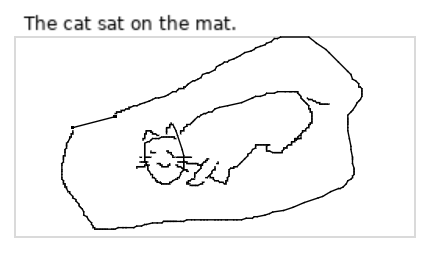
I've been working on lines.love, an editor for plain text where you can also seamlessly insert line drawings.
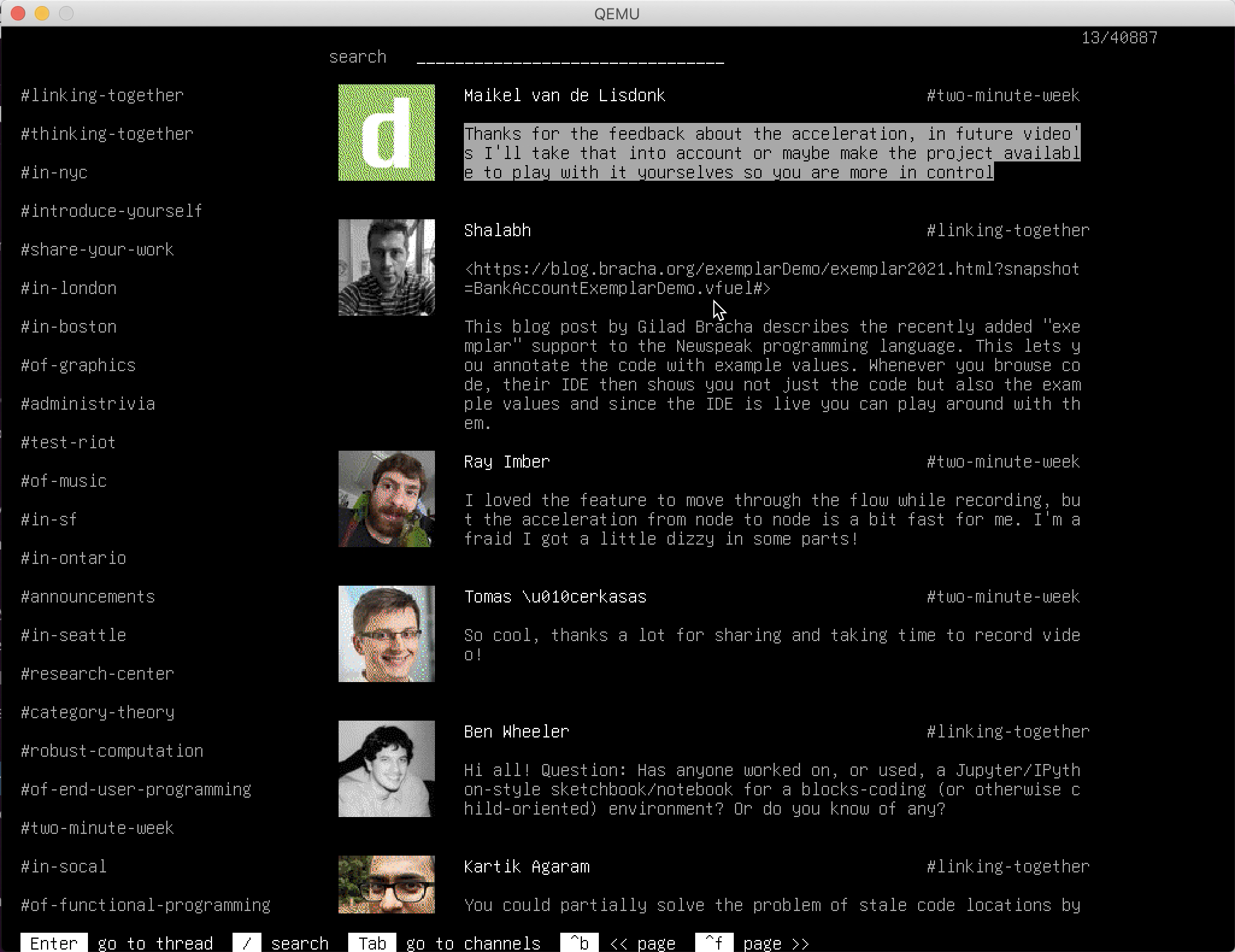
At FOSDEM 2022 I presented Teliva, a platform for habitable and auditable text-mode apps.
Some short demos about it:
I spent the pandemic year reading a lot of Peter Hamilton. I wouldn't necessarily recommend it; they all blur together after a while, and I start to wonder if they aren't perhaps all the same story…
Regardless, the first Peter Hamilton I read, Pandora's Star, still sticks with me for a motif that didn't come together until right at the end: the Silfen Paths. In this universe humanity has portals that can span light years, often conveying train service between star systems, but there are occasional legends of an older interstellar network by an ancient alien civilization. Needless to say, our intrepid protagonist manages to get on this network. And suffers years of privation and amazing adventures (while everyone else in the novel is moving the story forward) before coming out the other end. Unlike the portals created by humans, the Silfen paths don't contain abrupt transitions between two points in space. Things blend together more gradually. Also unlike portals, the Silfen Paths aren't in the traveller's control. Instead, to go forth on the paths is to open oneself to the new, the unexpected. Extreme heat and cold. Danger. The occasional prancing Silfen who'll happen upon you and help you out, but who doesn't quite seem to get the idea of “home,” or that you're trying to get there, before outpacing you again, inevitably leaving you behind to find your own path through the maze.
Instructions for trying it out.
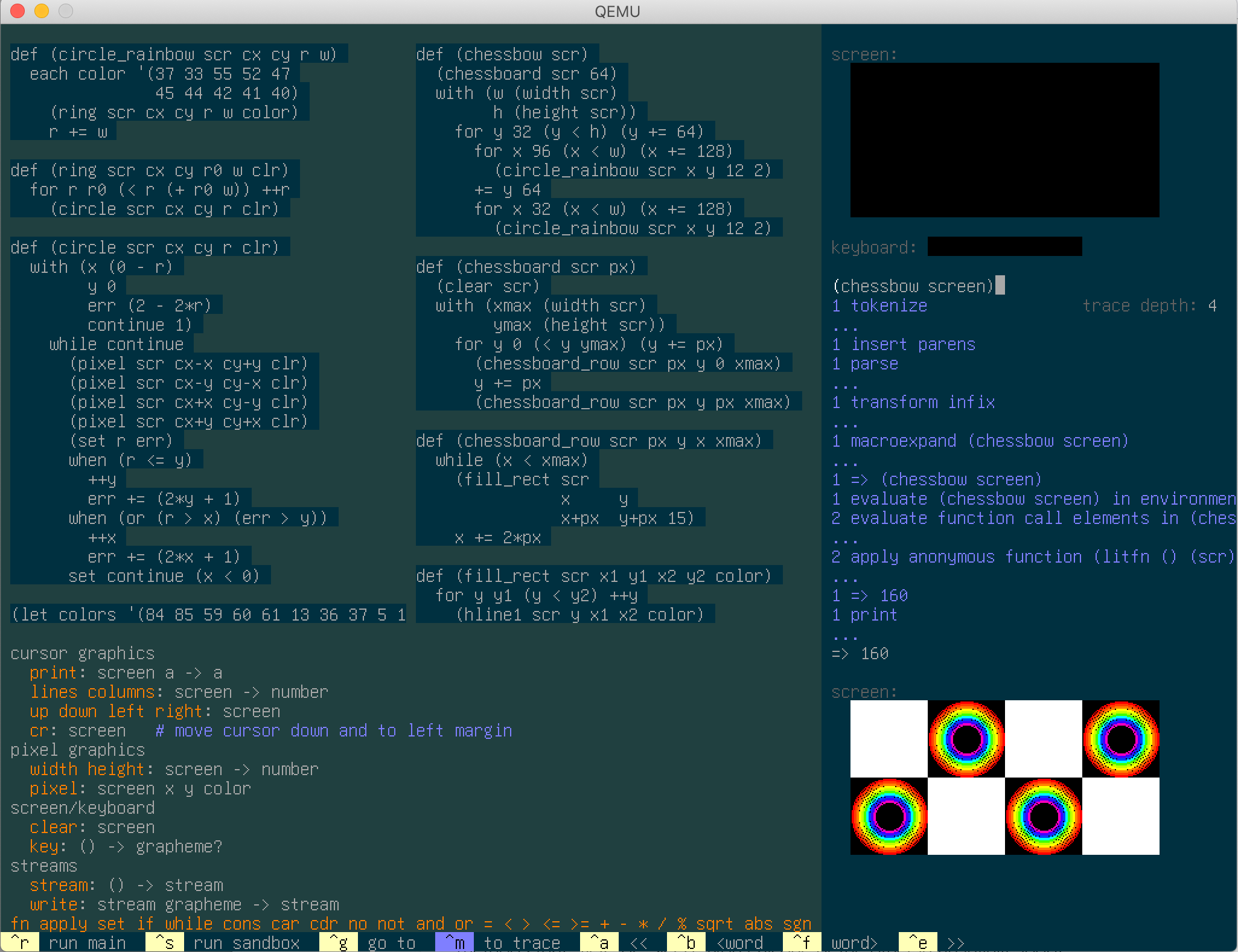
Instructions for trying it out.
Some demo videos:
My goal for Mu is software that is accountable to the people it affects. But it's been difficult to talk to people about Mu's goals because of the sheer number of projects that use similar words but lead to very different priorities and actions. Some of these I like to be associated with, some not so much.
if you care about making software accountable
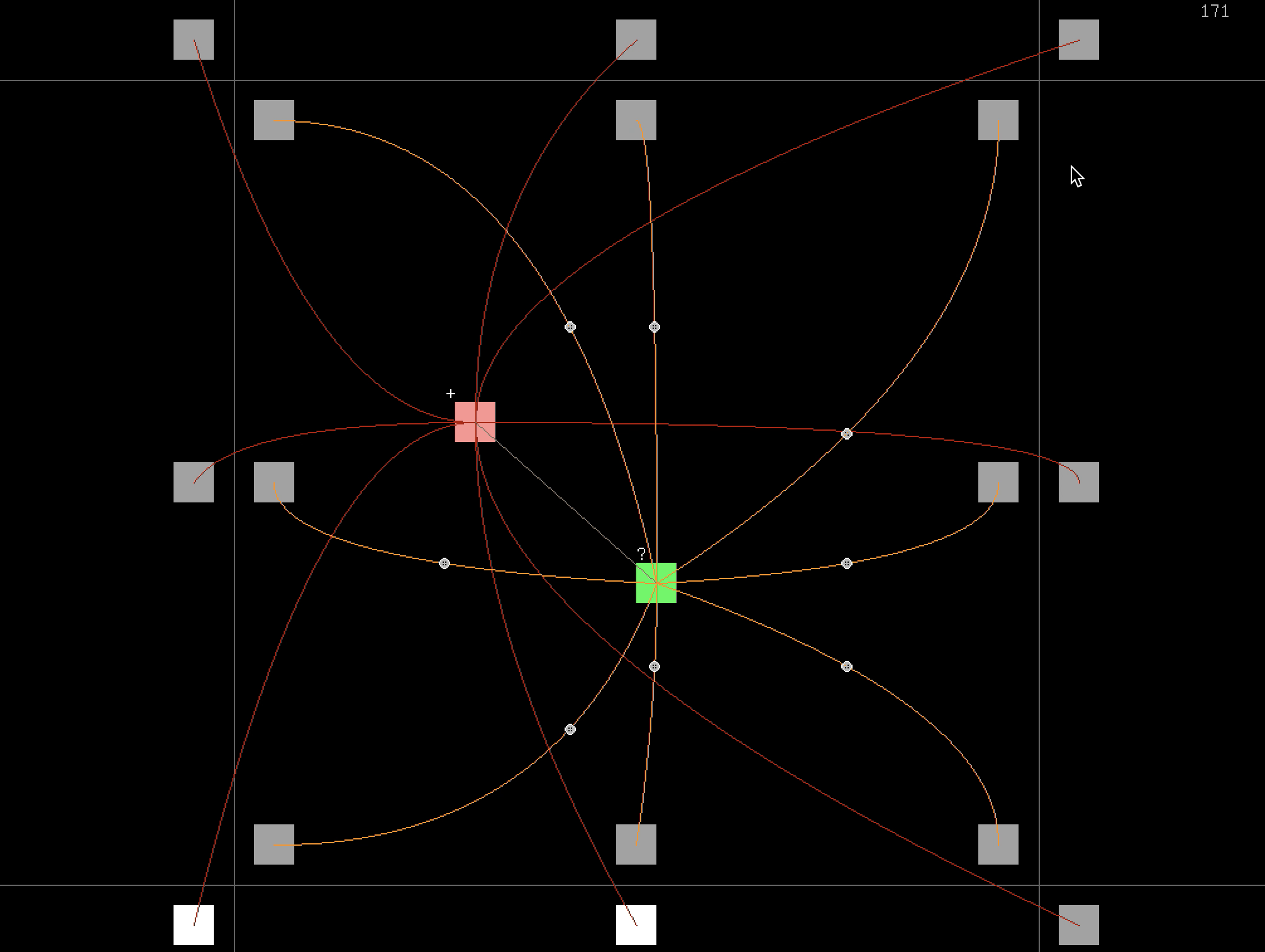
video (3 minutes)
Inspired in particular by episode 3, "Waterslide Kid" (2021-04-05) of the Hest podcast by Ivan Reese.
Instructions for trying it out.
It seems to me that modern computers trap people in a vicious cycle. Compatibility guarantees breed complexity over time as the world changes. Complexity is managed by introducing layers of abstraction. Abstractions introduce new compatibility guarantees. Over the decades this vicious cycle leads to even professional programmers understanding only a tiny fraction of the software infrastructure that runs their computers. As a result, our world is increasingly captured by software that is unaccountable to people.
For several years now I've had a vision for a computer that allows anyone to audit its inner workings, where any operation can be decomposed strictly into a parsimonious combination of simpler operations, terminating without cyclic dependencies or circular reasoning at some ground level. Ideally it would do this in a way that rewards curiosity, leading to a virtuous cycle where an order of magnitude more people grow to understand how their computer works as they use it.
Nowhere in this picture are compatibility guarantees, version numbers or forced upgrades. At any point your computer should be internally consistent and free of known historical accidents. Even if this means upgrades are more work and so more infrequent, and that our computers must be slower. Or do less. That seems like a worthwhile trade for a more sustainable world.
At the start of 2020 the state of the Mu computer looked like this: